
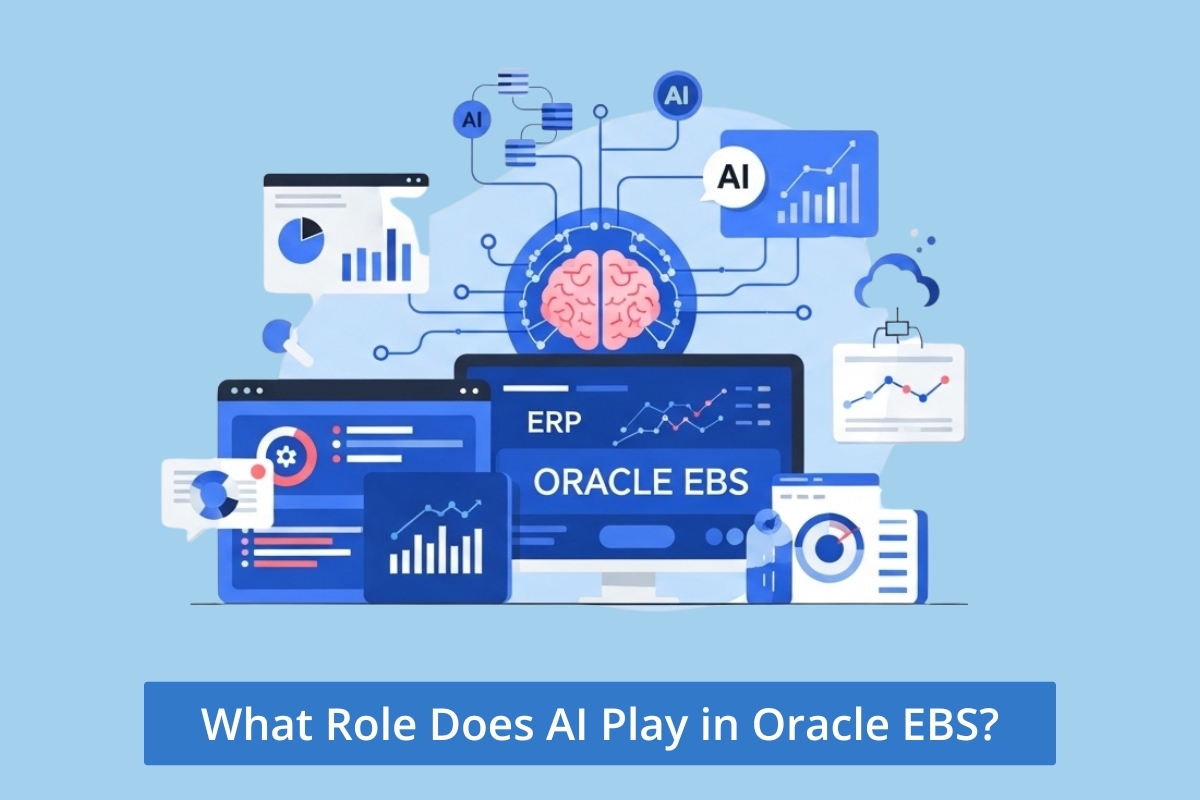
For many enterprises across the Middle East, Asia, and Europe, Oracle EBS is not just an ERP system,it is the backbone of finance, supply chain, HR, and operations. Even after decades in the market, Oracle EBS continues to run mission-critical workloads for governments, banks, telecom companies, manufacturers, and large trading groups.
But a common question keeps coming up:
If Oracle EBS is a mature system, what role does AI actually play in it today?
This article answers that question in simple, practical, and human language, without buzzwords. We’ll explain what Oracle EBS is, how it works, where AI fits in, what is realistically possible today, and how organizations are using AI with Oracle EBS rather than replacing it.
What Is Oracle EBS and How Does It Work?
Before talking about AI, it’s important to understand what Oracle EBS is and how it works.
Oracle EBS full form is Oracle E-Business Suite. It is a comprehensive ERP Oracle EBS platform that integrates core business functions into a single database and application framework.
At a high level:
- Data is stored in an Oracle Database
- Business logic runs through Oracle Forms, Reports, and PL/SQL
- Users access modules via Oracle EBS application interfaces
- Transactions flow across Finance, SCM, Manufacturing, and HR
Even today, many enterprises trust Oracle EBS ERP because it is:
- Stable
- Customizable
- Proven at scale
- Highly secure
That is why Oracle EBS is still widely used alongside newer cloud products.
Oracle EBS Components
Understanding Oracle EBS components helps clarify where AI can be added.
Core components include:
- Financials (GL, AP, AR, FA, CM)
- Supply Chain (Inventory, BOM, WIP, Purchasing)
- Manufacturing
- Order Management
- HRMS
- System Administration
Each module writes transactional data into a centralized database. This is critical,because AI works best where clean, historical data already exists, and Oracle EBS has exactly that.
Oracle EBS vs Fusion: Clearing the Confusion
Many people ask about Oracle EBS vs Fusion or Oracle Fusion vs Oracle EBS.
Here’s the simple difference:
- Oracle EBS: On-prem or private cloud ERP, highly customizable, process-heavy
- Oracle Fusion: Cloud-native ERP, faster innovation, less customization
Important point:
Oracle EBS is not obsolete. Many organizations run Oracle EBS cloud deployments (hosted on OCI, AWS, or Azure) and integrate AI externally.
This is where AI becomes powerful,not by replacing EBS, but by enhancing it.
Where Does AI Fit Into Oracle EBS?
Oracle EBS was not originally built with AI, but that doesn’t limit what you can do today.
AI in Oracle EBS typically works in three layers:
- Data Layer (Most Important)
Oracle EBS already stores:
- Years of transaction history
- Vendor behavior patterns
- Inventory movement
- Invoice and payment cycles
This makes it ideal for Oracle EBS data analytics with AI.
- Intelligence Layer (AI & ML)
Here, organizations apply:
- Machine learning models
- Predictive analytics
- Anomaly detection
- Forecasting algorithms
This is where machine learning in Oracle EBS delivers value.
- Action Layer (Automation)
Insights are pushed back into:
- Dashboards
- Alerts
- Approval workflows
- Reports
This enables Oracle EBS automation and Oracle EBS smart decision making.
Practical AI Use Cases in Oracle EBS
Let’s move away from theory and talk about AI use cases in Oracle EBS that companies are actually using.
- AI-Powered Invoice Processing
Finance teams deal with thousands of invoices every month.
With AI-powered Oracle EBS:
- AI validates invoice patterns
- Flags duplicate invoices
- Predicts late payments
- Improves approval routing
This directly improves Oracle EBS intelligent reporting and controls.
- Predictive Analytics for Finance
Using Oracle EBS predictive analytics, AI can:
- Forecast cash flow shortages
- Predict revenue trends
- Identify risky customers
- Finance leaders stop reacting late,and start planning early.
- Inventory Optimization Using AI
In Oracle EBS inventory management, AI helps
- Predict stock-outs
- Optimize reorder levels
- Reduce dead stock
This is one of the most successful Oracle EBS artificial intelligence use cases in manufacturing and trading companies.
- Intelligent Reporting Instead of Static Reports
Traditional Oracle EBS documentation and reports show what already happened.
AI-based reporting answers:
- Why did it happen?
- What will happen next?
- What should we do now?
This is Oracle EBS intelligent reporting in action.
- Process Automation Across Modules
Using AI with workflows enables:
- Auto-approval for low-risk transactions
- Exception-based approvals
- Reduced manual checks
This is true Oracle EBS process automation,without touching core code.
Common Technical Questions
How to find Oracle EBS version?
- You can find it by:
- Logging into EBS → About Page
Querying fnd_product_groups table
This is essential before planning any AI or integration work.
How to create more invoice on one PO in EBS Oracle?
Oracle EBS allows multiple invoices against a single PO as long as:
- PO quantity or amount is not exceeded
- Matching rules allow it
AI helps by detecting abnormal invoice splitting.
How to disable a field in Oracle Apps EBS?
Fields can be disabled using:
- Personalization
- Forms customization
- Function security
AI does not replace this,but it can recommend changes based on usage patterns.
How to populate view in Oracle EBS?
Views are populated through:
- Base tables
- Materialized views
- Custom SQL logic
AI uses these views for analytics without altering core data.
How to use insert statement in Oracle Reports for EBS?
Direct inserts are discouraged. Best practice:
- Use APIs or concurrent programs
- Maintain data integrity
AI models typically read,not write,transactional data.
Is Oracle ERP and E-Business Suite the same?
Yes, in common usage:
- Oracle ERP EBS usually refers to Oracle E-Business Suite
- Oracle also has cloud ERP under Fusion
What is OEEO in Oracle EBS?
OEEO (Oracle E-Business Suite Extended Operations) is often used internally to describe extended operational reporting or custom operational extensions built on EBS.
Do Saudi Arabia need DST patches in Oracle EBS R12.1?
Saudi Arabia does not currently observe Daylight Saving Time, but:
- Time zone patches
- Localization patches
- Hijri calendar updates
are still required. AI cannot replace compliance patching but can monitor risks and scheduling gaps.
AI vs Customization: A Critical Shift
Earlier, businesses solved problems by customizing Oracle EBS.
Today:
Customization = risk
AI = insight without breaking core logic
This shift is why Oracle EBS AI integration is growing rapidly.
Oracle EBS Tutorial Mindset: Learn Where AI Fits
If you are learning through an Oracle EBS tutorial, the key mindset is:
- Don’t rebuild EBS
- Extend it intelligently
- Let AI observe, learn, and advise
This keeps upgrades safe and costs under control.
Why Oracle EBS Still Matters in the AI Era
Despite new platforms, Oracle EBS remains powerful because:
- It holds trusted enterprise data
- It enforces structured processes
- It integrates well with AI platforms
That’s why enterprises choose AI-powered Oracle EBS, not ERP replacement.
Why AI and Oracle EBS Work Better Together Than Most People Think
There is a misconception that AI only works with “modern” cloud systems. In reality, AI performs best where business data is structured, validated, and historically rich,which is exactly how Oracle EBS environments are designed.
Most organizations running Oracle EBS have:
- 8–15 years of clean transactional data
- Strong approval workflows
- Mature business rules
- Stable master data
This makes Oracle EBS an ideal foundation for AI, even if the core application itself is not “AI-native.”
AI does not need to live inside Oracle EBS to deliver value. It needs access to EBS data, business context, and operational logic. That’s where the real advantage lies.
How AI Actually Connects to Oracle EBS (Without Breaking Anything)
One of the biggest fears enterprises have is:
“Will AI force changes in our Oracle EBS core system?”
The answer is no,if done correctly.
AI integration with Oracle EBS typically follows a non-invasive model:
- Read-only data access from Oracle EBS
- Data is processed externally (AI/ML layer)
- Insights are pushed back as:
- Reports
- Dashboards
- Alerts
- Recommendations
This ensures:
- No risk to transactional integrity
- No upgrade complications
- No dependency on heavy customization
That is why Oracle EBS artificial intelligence projects succeed when they respect the ERP’s boundaries.
AI in Oracle EBS Finance: Beyond Standard Reports
Finance teams are often the first to benefit from AI in Oracle EBS because financial data is structured and predictable.
Traditional Oracle EBS Finance Reports:
- Show balances
- Show aging
- Show historical variance
AI-Enhanced Oracle EBS Finance:
- Predicts cash shortages weeks in advance
- Flags vendors likely to dispute invoices
- Detects unusual posting behavior
- Identifies approval bottlenecks
This turns Oracle EBS intelligent reporting into a decision-support system rather than a reporting tool.
CFOs stop asking “What happened?”
They start asking “What should we do next?”
AI in Oracle EBS Supply Chain and Inventory
Supply chain is another area where machine learning in Oracle EBS delivers massive impact.
Common Problems Without AI:
- Overstocking slow-moving items
- Frequent emergency purchases
- Manual reorder decisions
- Poor demand forecasting
What AI Adds:
- Demand pattern recognition
- Seasonal trend prediction
- Vendor reliability scoring
- Inventory risk alerts
In Oracle EBS inventory management, AI does not replace planners,it supports them with better foresight.
Oracle EBS Automation: Small Changes, Big Results
Automation in Oracle EBS does not mean “fully robotic systems.” It means reducing unnecessary manual work.
AI enables:
- Auto-approval for low-risk invoices
- Smart routing of purchase requests
- Exception-based approvals only
- Intelligent reminders and alerts
This is Oracle EBS process automation done the right way,focused on efficiency, not disruption.
AI and Compliance in Oracle EBS (Especially for GCC & Saudi Arabia)
Compliance is a major concern in regions like Saudi Arabia, UAE, and the wider GCC.
AI helps Oracle EBS users by:
- Monitoring tax-related transactions
- Identifying unusual compliance patterns
- Highlighting DST, time-zone, or localization risks
- Supporting audit readiness
For example, while Saudi Arabia does not currently require DST patches, AI can still:
- Monitor date/time inconsistencies
- Flag misaligned reporting periods
- Detect system behavior anomalies after patches
AI becomes a silent compliance assistant, not a replacement for functional expertise.
Oracle EBS Cloud + AI: A Practical Modernization Path
Many organizations hesitate to migrate to Fusion but still want modernization.
This is where Oracle EBS cloud hosting combined with AI becomes powerful.
Benefits include:
- Scalability without ERP replacement
- Easier AI integration
- Better analytics performance
- Lower infrastructure risk
This approach keeps Oracle EBS stable while allowing innovation around it.
AI vs Custom Reports in Oracle EBS
Traditional Oracle EBS environments rely heavily on:
- Custom reports
- Excel-based analysis
- Manual reconciliations
- AI changes this dynamic.
Instead of writing dozens of reports:
- AI highlights what matters
- Users drill down only when needed
- Time spent on analysis drops significantly
This is why Oracle EBS data analytics with AI is becoming more popular than heavy reporting customization.
Realistic Expectations: What AI Will NOT Do in Oracle EBS
To keep expectations grounded, it’s important to be honest.
AI will NOT:
- Replace Oracle EBS core modules
- Eliminate the need for functional consultants
- Automatically fix bad data
- Remove governance responsibilities
AI works best when:
- Business processes are stable
- Data quality is managed
- Users understand ERP fundamentals
- Think of AI as an intelligent advisor, not a miracle replacement.
Oracle EBS vs Fusion Revisited: A Smarter Perspective
Instead of asking:
“Should we move from Oracle EBS to Fusion?”
A better question is:
“Where does AI give us the fastest value?”
Many organizations now:
- Keep Oracle EBS for core operations
- Use AI for analytics and automation
- Gradually evaluate Fusion modules
This hybrid approach is financially safer and operationally smarter.
AI Helps Reduce Oracle EBS User Fatigue
One overlooked benefit of AI is user experience improvement.
Oracle EBS users often struggle with:
- Information overload
- Complex navigation
- Manual follow-ups
AI simplifies their work by:
- Highlighting priorities
- Reducing noise
- Offering contextual insights
This leads to:
- Higher user adoption
- Fewer errors
- Better decision confidence
Oracle EBS Implementation + AI: Timing Matters
If you’re planning a new Oracle EBS implementation, AI should not be added on Day One.
Best practice:
- Stabilize core ERP processes
- Ensure clean data
- Train users
- Introduce AI gradually
AI amplifies what exists,it does not fix broken foundations.
AI and Oracle EBS Documentation: Smarter Knowledge Access
Many teams struggle with:
- Scattered Oracle EBS documentation
- Tribal knowledge
- Dependency on a few experts
AI can:
- Search historical tickets
- Analyze transaction behavior
- Provide context-aware insights
This reduces reliance on manual documentation and improves continuity.
Strategic Value of AI in Oracle EBS for Leadership
From a leadership perspective, AI transforms Oracle EBS from:
- A transaction engine
- Into a strategic intelligence platform
Executives gain:
- Faster insights
- Predictive visibility
- Reduced operational blind spots
This supports Oracle EBS smart decision making at the highest level.
The Long-Term Future of Oracle EBS with AI
Oracle EBS is not standing still.
Its future lies in:
- Stability at the core
- Intelligence at the edges
- Integration with modern analytics
- Controlled, low-risk modernization
AI ensures Oracle EBS remains relevant, competitive, and valuable for years to come.
The Human Side of AI in Oracle EBS
When people talk about AI in enterprise systems, the conversation often becomes technical very quickly. But inside organizations running Oracle EBS, the real impact of AI is felt by people, not systems.
Finance managers stop chasing numbers late at night.
Procurement teams stop guessing which supplier might delay deliveries.
Operations leaders stop reacting after problems occur.
AI does not make Oracle EBS “smarter” in isolation. It makes people more confident in the decisions they make using the system.
That confidence is one of the most underestimated benefits of AI in Oracle EBS environments.
Why Clean ERP Data Gives AI a Huge Advantage
AI fails when data is messy. That’s why many AI projects struggle outside ERP systems.
Oracle EBS already enforces:
- Validation rules
- Approval hierarchies
- Accounting controls
- Master data discipline
Because of this, AI models trained on Oracle EBS data tend to be far more accurate than models trained on loosely structured systems like spreadsheets or ad-hoc databases.
This is why AI in Oracle EBS delivers practical insights rather than theoretical predictions.
From Static Screens to Living Intelligence
Traditional Oracle EBS screens were designed for transaction entry, not insight.
Users log in, enter data, run reports, and log out.
AI changes this experience by shifting focus from screens to signals:
- Signals that highlight unusual behavior
- Signals that show upcoming risks
- Signals that suggest action
Instead of navigating multiple forms and reports, users receive contextual intelligence tied directly to Oracle EBS data.
This does not replace Oracle EBS screens,it makes them more meaningful.
AI and Change Management in Oracle EBS Environments
One reason Oracle EBS has survived so long is that organizations resist frequent change. Stability matters.
AI fits well into this mindset because:
- It does not force process redesign
- It does not require retraining entire teams
- It can be introduced gradually
- Users continue working the same way, but with better visibility.
This reduces resistance and increases adoption,two challenges that usually derail ERP improvement initiatives.
Reducing Decision Fatigue in ERP-Driven Organizations
Decision fatigue is real, especially in large organizations.
Oracle EBS users make hundreds of micro-decisions every day:
- Which invoice to prioritize
- Which PO needs attention
- Which inventory item is risky
AI helps by filtering noise and highlighting only what matters.
Instead of reviewing everything, users focus on:
- Exceptions
- Trends
- High-impact risks
This makes work less exhausting and more effective.
AI as a Bridge Between Technical and Business Teams
In many Oracle EBS environments, there is a gap between:
- Technical teams who understand the system
- Business teams who understand operations
AI helps bridge this gap by translating raw data into business language.
Instead of SQL queries or complex reports, business users see:
- Clear indicators
- Simple visual patterns
- Action-oriented insights
This reduces dependency on technical teams and improves collaboration.
Why AI Extends the Life of Oracle EBS
Many organizations worry about the long-term future of Oracle EBS.
AI changes that conversation.
By adding intelligence around the system, Oracle EBS becomes:
- More responsive
- More strategic
- More aligned with modern decision-making
This extends the system’s relevance without forcing migration or reimplementation.
Oracle EBS remains the system of record, while AI becomes the system of insight.
AI and Risk Management in Oracle EBS
Risk rarely appears suddenly. It builds quietly.
- Late payments.
- Slow-moving inventory.
- Unusual approvals.
Oracle EBS captures these signals, but humans often see them too late.
AI spots these patterns early, giving organizations time to act before problems escalate.
This shifts risk management from reactive to preventive.
A More Sustainable Way to Modernize ERP
ERP modernization is often expensive, disruptive, and risky.
AI offers a more sustainable path:
- No replacement of core ERP
- No loss of historical data
- No major retraining programs
Instead, organizations enhance what already works.
For Oracle EBS users, this approach delivers modernization without chaos.
Oracle EBS in a World of Speed and Uncertainty
Markets move faster than ever.
- Prices change.
- Demand fluctuates.
- Regulations evolve.
Oracle EBS provides control and consistency. AI adds speed and foresight.
Together, they create a balance that modern organizations need:
- Stability without rigidity
- Intelligence without disruption
That balance is why Oracle EBS continues to hold its place in enterprise IT landscapes.
The Quiet Impact of AI on Everyday ERP Work
Not every benefit of AI shows up on a dashboard.
Some are subtle:
- Fewer urgent emails
- Fewer last-minute escalations
- Fewer manual reconciliations
Over time, these small improvements compound into significant operational gains.
That is the real role of AI in Oracle EBS,not flashy automation, but quiet efficiency that improves daily work.
How Aitropolis Helps You Unlock AI in Oracle EBS
Turning Oracle EBS Data Into Intelligent Decisions
At Aitropolis, we help organizations modernize Oracle EBS without disruption.
We specialize in:
- AI integration with existing Oracle EBS environments
- Predictive analytics for finance and supply chain
- Intelligent dashboards and reporting
- Process automation without risky customization
- Oracle EBS cloud modernization strategies
Our approach respects what already works,while adding intelligence where it matters most.
You don’t need to migrate to get smarter. You need clarity, data, and the right AI layer.
FAQs
Is AI built into Oracle EBS by default?
No. AI is integrated externally using analytics, ML models, and reporting layers.
Can Oracle EBS work with AI without upgrading to Fusion?
Yes. Many enterprises run AI on top of existing EBS versions.
Is Oracle EBS still supported?
Yes. Oracle continues to support and extend EBS with long-term roadmaps.
Does AI replace Oracle EBS users?
No. AI assists users by improving accuracy, speed, and decision quality.
Is Oracle EBS cloud-ready for AI?
Yes. Especially when hosted on OCI, AWS, or Azure with analytics services.
Leave a Reply